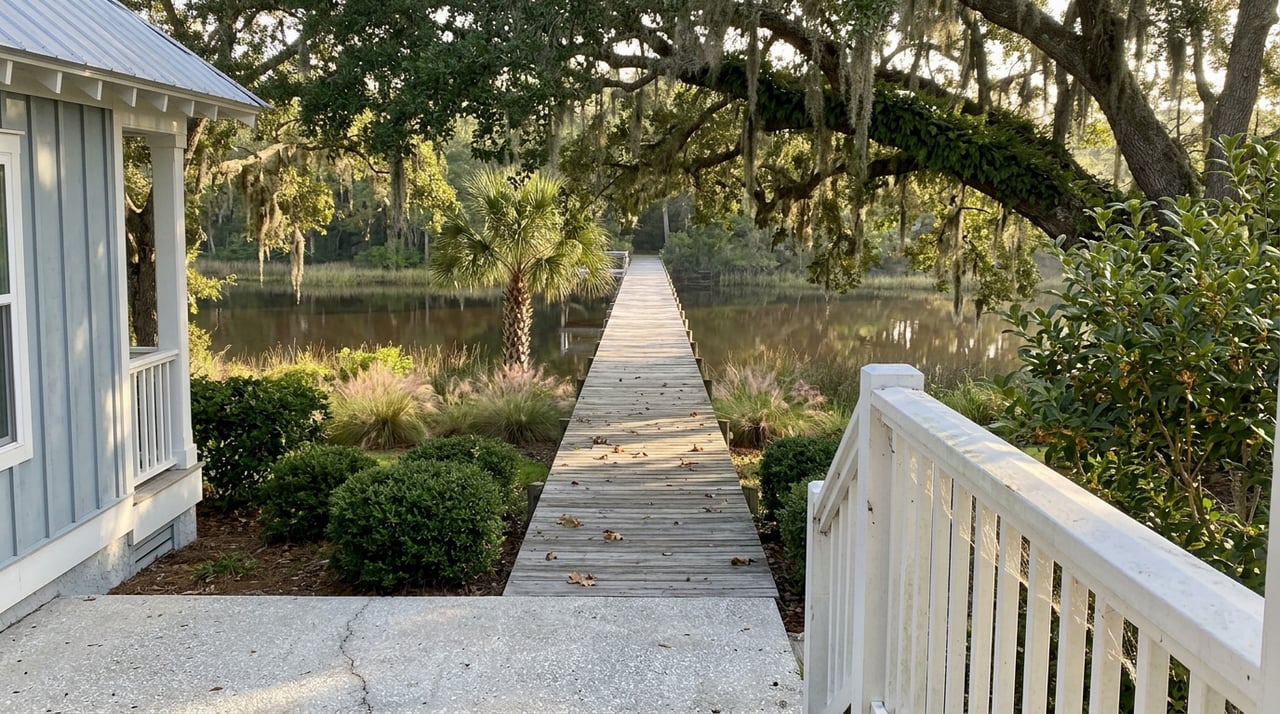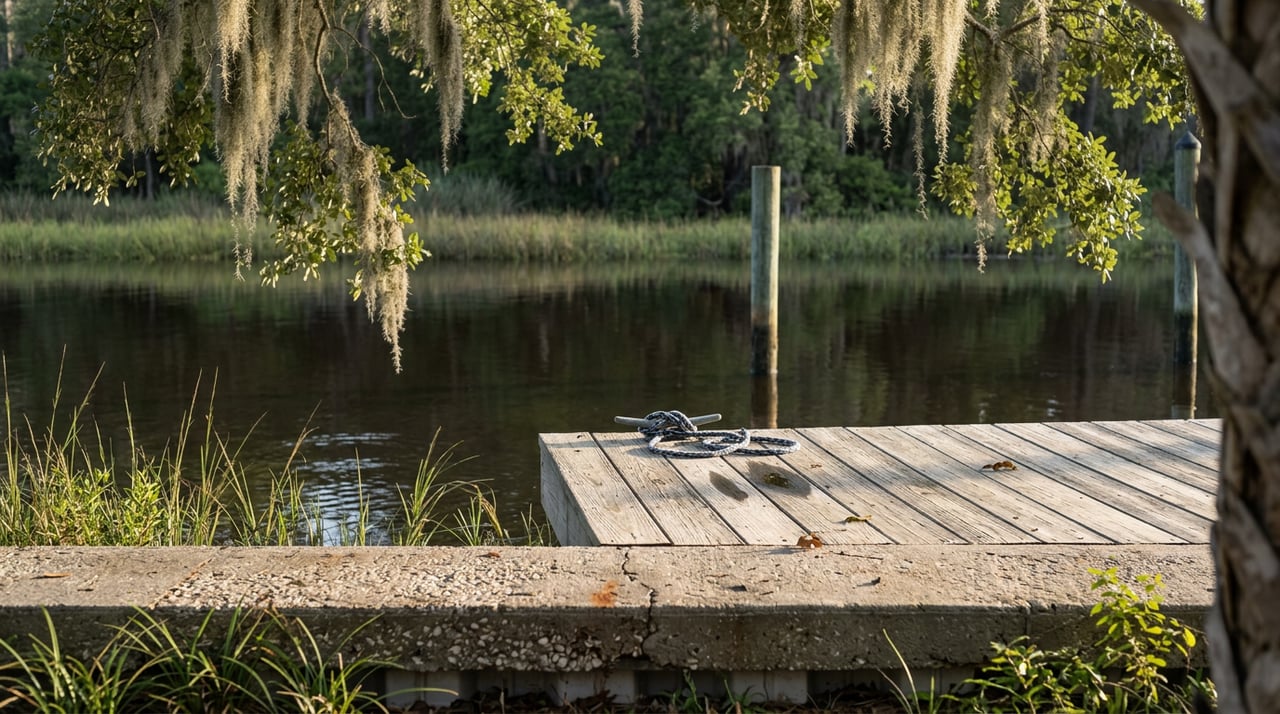
Walk any harbour-side street in Wexford and the dock behind the house looks like the simplest part of the sale. It's already there. It's already built. The listing photo shows a boat tied up at golden hour and the assumption writes itself: this comes with the house, done deal.
It doesn't work that way, and the gap between what a dock looks like and what it legally is turns out to be the single most consequential thing a buyer can misunderstand about waterfront property in this community. What you're actually acquiring when you close on a home with a private dock in Wexford is not a fixed structure. It's a permit history, frozen at a specific footprint, that the state of South Carolina will let you maintain but not necessarily expand.
Two different products, one word on the listing sheet
Wexford's 37-acre inland harbour uses a lock system, one of only three on the East Coast, that keeps water depth close to a constant seven to eight feet regardless of tide. It connects through Broad Creek to the Intracoastal Waterway and can handle vessels up to 70 feet with beams to 19 feet. That's the amenity everyone pictures.
But "waterfront in Wexford" actually describes two different products. The harbour holds 280 boat slips total, and according to Wexford's own harbour page, 138 of those sit directly behind privately owned homes. The rest are clubhouse slips, managed as a shared amenity rather than tied to any single deed. A private backyard dock is a permitted structure regulated by the state. A clubhouse slip is a membership benefit administered by the club. They get lumped together as "dock access" in casual conversation and on portal listings, but they carry completely different legal weight when you're the one signing a purchase agreement.
What the state actually lets you keep
South Carolina's coastal regulations, administered today by the Department of Environmental Services (the successor agency to DHEC's old Office of Ocean and Coastal Resource Management), treat an existing dock as grandfathered if it was previously permitted and remains generally intact in its current condition. That status lets an owner repair and maintain the structure.
What it does not let an owner do is rebuild it bigger, add to its footprint, or change how it's used, without going back through the permitting process from scratch. The regulation is specific: work on a grandfathered structure may only extend to its original dimensions, and any expansion or major rebuilding requires a fresh permit or written approval from the department.
A grandfathered dock can be repaired to the footprint it already has. It cannot be quietly enlarged, extended, or repurposed without the state signing off again.
That single distinction is why two docks that look identical from the water can carry very different value. One has a clean permit history that matches its current footprint exactly. The other was rebuilt at some point past what the original permit allowed, which means the current structure may not actually be legal as built, a fact that surfaces at the least convenient moment: during due diligence, or during a future storm-damage claim.
The timeline gap that changes how you should think about price
Here is where the practical stakes show up. A private residential dock repaired to its existing, grandfathered footprint typically moves through South Carolina's minor-activity permitting in a matter of months. New construction or any expansion of that footprint pulls in a longer review that can stretch well past a year.
That gap matters if you're buying a home where the dock needs real work, or where you're picturing a bigger dock, a boat lift, or a slip that can handle a larger vessel than the current owner's. If the work stays inside the existing footprint, you're likely looking at a repair project measured in months. If it doesn't, you're looking at a permitting process measured in more than a year, which changes how you should price the home, plan your first season on the water, or time a sale if you're the one moving on.
| Scope of work | Permit path | Rough timeline | Wexford ASC review required |
|---|---|---|---|
| Repair within existing, grandfathered footprint | State minor-activity permit | Typically a few months | Yes, before work begins |
| Storm damage restored to prior size and location | State emergency general permit | Varies by event | Yes, before work begins |
| New dock, expanded footprint, or added structure | State permit review | Can extend well past a year | Yes, before work begins |
Wexford adds its own gate before the state's
Even a straightforward repair inside the existing footprint doesn't skip community review. Wexford's Architectural Standards Committee governs docks, seawalls, and bulkheads under its own guidelines, with a dedicated section covering dock construction, dock dimensions, and rules specific to docks along Broad Creek. The ASC office sits at Village of Wexford, Suite J-18, and the committee meets at least once a month, typically the second and fourth Tuesday, to review submissions.
Application fees for projects touching docks, bulkheads, landscaping, or major renovations run from roughly $100 to $5,000 depending on scope, and no construction can begin until the ASC has issued its approval, whether that approval comes as a full committee sign-off or a simpler staff-level review for minor work. Once a renovation wraps, the owner still owes the community a new as-built survey documenting exactly what changed. A buyer who assumes the state permit is the only paperwork that matters will be surprised to learn the community layer runs on its own separate clock.
Who's actually allowed to do the work
If the dock needs anything beyond cosmetic upkeep, South Carolina law draws a hard line on who can legally do it. Any construction project over $5,000 requires a state-licensed marine contractor carrying a marine construction stipulation. American Dock and Marine, a South Carolina marine contractor that works directly with state and federal permitting offices, confirms this threshold and notes that private residential dock permits generally take around 120 days to move through the process when the work stays within an already-permitted footprint.
That timeline is the encouraging half of the story. It means a straightforward repair to a documented, grandfathered dock is a manageable project, not a yearlong ordeal. But it only holds if the paperwork actually matches the structure in the water.
Before you write an offer
A private dock in Wexford is worth doing this homework on before it's under contract, not after.
- Ask for the state permit number tied to the dock and confirm the permitted dimensions match what's actually built.
- Find out whether any dock, bulkhead, or seawall work has happened since the original permit, and whether it went through both state review and the Wexford ASC.
- Request the ASC approval letter or as-built survey on file for the most recent work, if any.
- Clarify whether the property includes a private backyard dock or an assigned harbour slip.
- If you're planning to add anything, a lift, an extension, a larger slip, ask your agent to flag that early.
A few questions worth asking directly
Does a clubhouse harbour slip transfer the same way a private dock does? Not exactly. A harbour slip is a club-managed amenity rather than a structure tied to your deed, so the relevant question shifts from state permit status to how the club assigns and transfers slip access.
What if a previous owner rebuilt the dock without documentation? That's a reason to check the permit history against the structure before you commit.
Does any of this affect insurance? Insurers underwriting a waterfront property typically want to see that structures on the parcel, including the dock, match what's on file with the state and the community. A mismatch is the kind of thing that surfaces during underwriting, not after.
The dock behind a Wexford home is real, useful, and often the entire reason someone falls in love with the property. It's also a piece of regulated infrastructure with a paper trail that matters more than its current coat of sealant. Knowing which one you're buying, a documented asset or an undocumented liability wearing the same boards, is the difference between a smooth first season on the water and a permitting process that outlasts your first year of ownership.
If you're evaluating a Wexford property with a private dock or a harbour-side slip, the Lynne Anderson Luxury Team can help you pull the permit history, confirm ASC compliance, and understand exactly what you'd be taking on before you write an offer. Schedule a free consultation to walk through the specifics of any listing you're considering.
This article is general information, not legal, tax or financial advice. Consult a qualified professional about your situation.